Invasive Species
Tree of Heaven
Ailanthus altissima
A fast-growing tree that poisons the soil around it and is the favorite host of the spotted lanternfly.
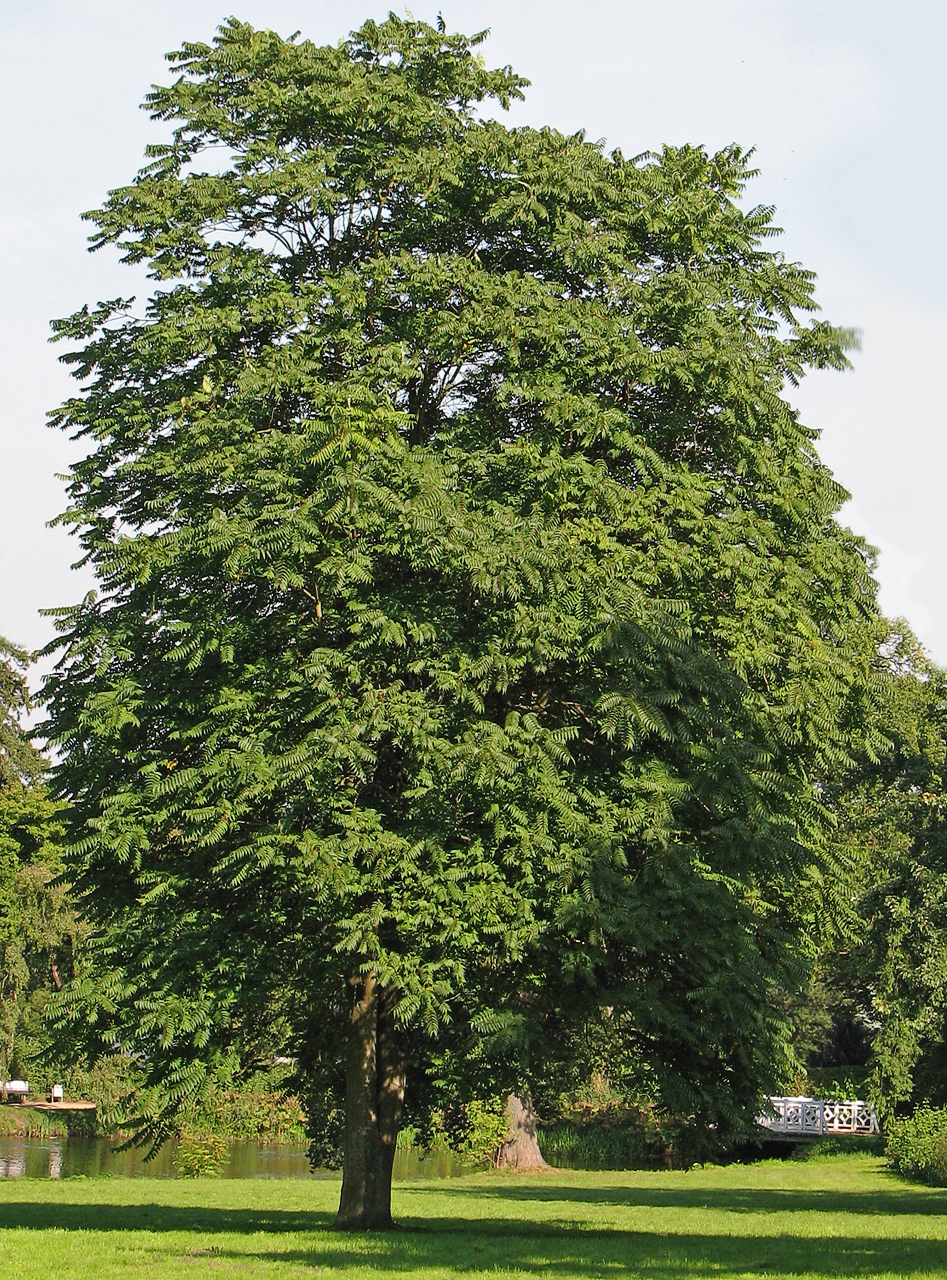
📝 Draft content — written for your review. Verify the identification and removal details before publishing.
Why it’s harmful
Tree of Heaven is one of the most aggressive invasive trees in the Northeast. It grows astonishingly fast — up to several feet a year — and reproduces both by prolific wind-blown seeds (a single tree can produce hundreds of thousands) and by sending up dense “suckers” from its spreading roots.
- It releases a chemical (ailanthone) into the soil that suppresses the growth of nearby native plants — a strategy called allelopathy.
- It forms dense thickets that crowd out native trees and shrubs pollinators depend on.
- It is the preferred host of the spotted lanternfly, a destructive invasive insect that threatens fruit trees, grapes, and hardwoods.
- Its aggressive roots can damage sidewalks, foundations, and sewer lines.
How to ID it
- Leaves: very large compound leaves, 1–4 feet long, each with 11–41 leaflets arranged along a central stem.
- Leaflet detail: each leaflet is smooth-edged except for one or two small “teeth” near its base, each with a tiny bump (gland) underneath. This is the most reliable ID feature.
- Smell: crushed leaves and broken twigs give off a strong, unpleasant odor often compared to rancid peanut butter or cat urine.
- Bark: smooth and gray, sometimes likened to the skin of a cantaloupe.
- Seeds: female trees carry large drooping clusters of papery, twisted seeds (samaras) in late summer, often tinged red.
Look-alikes: Native sumac and black walnut have similar compound leaves, but their leaflets are toothed all the way around and they don’t have the foul smell.
📸 5 photos to help you recognize it in different settings and seasons.Click any photo to enlarge and browse.
How to remove it
Tree of Heaven fights back hard, so method matters more than effort.
- Seedlings: pull young plants by hand when the soil is moist, getting the whole root.
- Don’t just cut it down. Cutting or mowing a established tree triggers an explosion of root suckers and stump sprouts — you’ll end up with many trees instead of one.
- Established trees: the most effective approach combines herbicide with cutting — a “cut-stump,” “hack-and-squirt,” or basal-bark application of triclopyr or glyphosate, applied in mid-to-late summer when the plant is moving energy down to its roots.
- Dispose carefully: bag and trash seeds and any female flower clusters so they can’t spread.
- Be persistent: expect to monitor and re-treat over several seasons.
If you spot the spotted lanternfly on or near these trees, report it to the Massachusetts Department of Agricultural Resources.
Sources and local guidance vary — when removing invasives, follow the latest advice from groups like the Massachusetts Invasive Plant Advisory Group (MIPAG) and your local conservation commission.